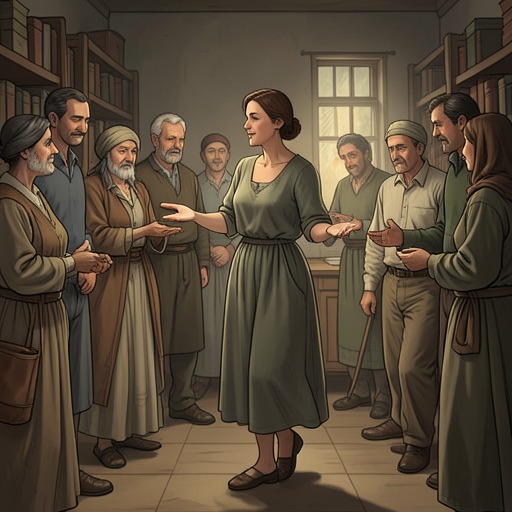
Anne
Stranger in a Strange LandAnne is a Fair Witness in Jubal Harshaw’s household: a woman whose exact memory and disciplined attention make her both an observer of consequential events and, increasingly, a participant in the Martian practices reshaping the people around her. Her progression from a quiet recorder in a white cloak to someone capable of rapport with Mike gives her an understated but revealing arc: her gentleness does not mean passivity, and her reserve conceals substantial inner development.
Identity and Place in the Household
Anne is one of three women in Harshaw’s household who are generally referred to by first name rather than surname. She is blonde, and her appearance is described as authentically so; the three women range in build from pleasantly plump to slender, span fifteen years in age, and are difficult to rank by age at a glance. One is rumored to be Harshaw’s granddaughter, but no one agrees which. The uncertainty and casual naming reflect the household’s informal domestic order, where their place is more evident than any formal genealogy.
Anne’s defining professional identity is that of a Fair Witness. Her total-recall memory means she has no need for recording devices: when Harshaw asks her to join a conversation, she can listen and retain its particulars without taking notes. The role is visible as well as intellectual. At a televised appearance with Harshaw and Mike, she stands in view in her white cloak, which functions as a recognizable emblem of probity, even though Harshaw does not introduce her to the Secretary General. Later, when called upstairs, she arrives already cloaked and ready to observe. The image of Anne in white recurs as a sign of disciplined witnessing amid events that others experience as bewildering or politically charged.
Observation and Evidence
Harshaw makes Anne’s observational discipline concrete by asking her to identify the color of a newly built house on a distant hilltop. Her work is not merely a matter of storing information: it requires separating what can be directly seen from what might be assumed. That exactness becomes especially useful when Mike’s extraordinary abilities challenge ordinary expectations about physical events.
After a box disappears, Harshaw asks whether Anne was watching. Her account preserves the sequence and limits of what she saw: the box seemed to shrink rapidly, the disappearance took a measurable fraction of a second, and she could see it until the instant it vanished. She does not claim to know what happened beyond the observation itself. The careful distinction between the appearance of recession and the fact that the box remained inside the room makes her testimony unusually informative without pretending to explain the phenomenon.
That capacity also marks a difference between Anne’s outwardly familiar manner and the quality of her attention. While the others react to Mike’s abilities with varying degrees of excitement or concern, Mike senses in Anne a cold, unyielding discipline resembling that of a Martian Old One. The perception startles him because Anne is usually soft, gentle, and warmly friendly. Her character thus holds together two qualities that might appear opposed: approachable kindness and an interior rigor that becomes legible when the situation demands it.
Relationships and Domestic Life
Anne’s relation to Harshaw is grounded in mutual trust. When he asks whether he has ever been rude to her or to the other women, Anne answers that he has never been rude to any of them. The exchange presents household loyalty not as submission but as a judgment she can state plainly. Harshaw relies on her memory and presence, and her willingness to answer him makes that reliance part of their ordinary domestic life.
She also has a distinct perspective on Mike’s effect on other people. Speaking about his kisses, Anne contrasts them with the divided attention she has encountered from men: Mike, she says, brings his entire attention to the person he is kissing, without technique or a competing plan. For Anne, that complete presence makes the moment feel overwhelming. Her account connects Mike’s unusual attention to the broader relational ethic developing around him: intimacy is experienced not as performance but as undivided attention to another person.
Anne takes part in the household’s practical and social routines as well. She offers Jill guidance about buying a present, rejecting clothes and jewelry before selecting something that puzzles Harshaw because Jill already smells exactly as she should. She comments on Harshaw’s taste in sculpture, observing that the books in his study might offer a clue but probably would not settle the problem. When Ben Caxton and Mahmoud visit while Jill is away, Anne, Miriam, and Dorcas help make the household’s hospitality bearable for the disappointed Ben and the visiting Mahmoud. These moments place Anne within the everyday labor and companionship that hold the house together, not only in its extraordinary encounters.
Learning and Participation
Anne’s movement toward Martian practice is gradual but substantial. By the time Mahmoud describes her progress, she has used her total-recall memory to learn Martian with remarkable speed and has established rapport with Mike. Mahmoud says she is far more advanced than she has allowed others to know. He further explains that she can help Ben enter rapport through Dawn’s assistance, after which Anne herself can guide him in the next lesson. Her development turns the Fair Witness’s attentiveness into a means of connection: she is no longer only recording what others experience but helping another person approach it.
The water-sharing practices of the household show the seriousness of the bonds being formed. When Jill explains the ritual to Patricia Paiwonski, Anne is among those included in the account of trust, partnership, and obligations that cannot be casually broken. Patricia chooses to participate. The episode clarifies the social world Anne inhabits: sharing water is not an incidental gesture but a solemn relation whose demands are made explicit before a person accepts it. Elsewhere, the Nest’s Innermost Temple is described as the place where new brothers are received, with a central pool used for sharing water and growing closer. These ceremonies offer a formal counterpart to the quieter bonds Anne already sustains in Harshaw’s home.
The book also links Anne to the household’s more advanced stages of spiritual practice. Harshaw notes that Mike may invite someone to share water before that person reaches the Seventh Circle, citing Sam and Ruth, whom Mike chose while they had just entered the Third Circle; they later became a priest and priestess. This account establishes that the circles do not operate as a simple gatekeeping ladder: individual readiness and Mike’s judgment can alter the timing of progression. Anne’s own advanced state, disclosed through her language learning and rapport, fits this picture of development that may precede public recognition.
Judgment, Change, and Significance
Anne’s testimony about sculpture offers another measure of how her judgment changes. Asked to look carefully at Rodin’s masterpiece, she recalls that she first found it horrible but has come to think it may be the most beautiful thing she has ever seen. The change is not presented as a sudden conversion or an imposed verdict: she describes a conclusion reached over time. Her response suggests an ability to remain with an unsettling object long enough for perception to change, a discipline akin to her careful witnessing but not reducible to it.
As the story advances, Anne’s public image remains composed. Before a later appearance, she is ready in her floor-length Fair Witness cloak, while Duke arrives in deliberately disheveled press attire with cameras and equipment. The contrast places Anne’s formal dignity beside Duke’s theatrical presentation, while both are present as part of the work of making events visible. Her cloak continues to signify a commitment to witness, but her growing command of Martian language and rapport shows that she has crossed beyond the role of detached observer.
Anne’s significance lies in that crossing. Her total recall first makes her valuable as a precise witness; her testimony about the disappearing box demonstrates the limits as well as the force of such observation. Her warmth makes her a trusted presence in the household, while her unexpectedly austere discipline becomes perceptible to Mike. Finally, her learning and rapport reveal that disciplined attention can develop into participation and connection. Anne does not abandon the Fair Witness’s exactness as she changes; instead, the narrative presents that exactness as one of the capacities through which she can enter a new understanding.